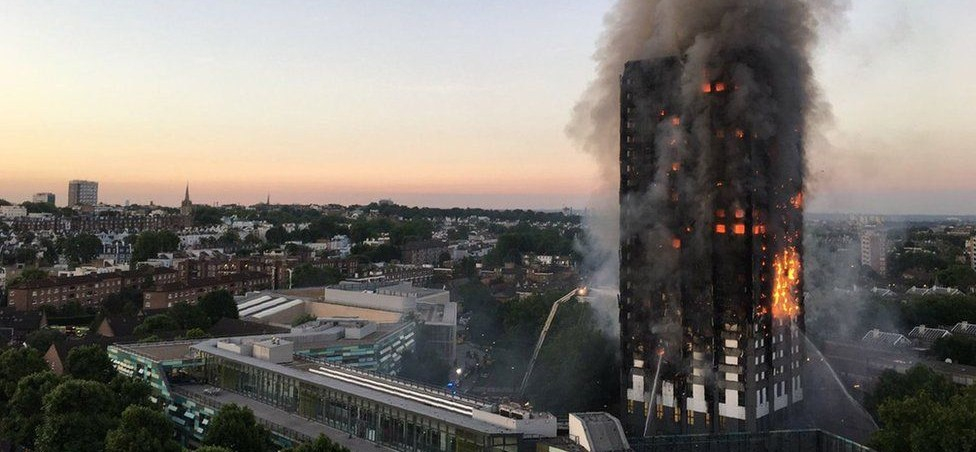
Following the one year anniversary since the tragedy of the Grenfell Tower fire in London, this article will be paying homage by asking the question, does an event change our reaction to art?
Grenfell Tower sparked a national controversy into what extent the government were accountable for negligence and class discrimination. Headlines declared the government should be responsible for manslaughter, calling the incident “criminal” (Daily Mirror) and demanding that we should “arrest the killers” (Metro). The event also sparked protests within the city.
Contemporary art isn’t shy to the exploration of socio-political criticism. Many artists use art as a means of activism, be it of class, race or gender (to name a few) art is a strong playing field in challenging society. This can be seen in comparison to Rachel Whiteread and Marwan Rechmaoui’s exhibition held at the Tate Modern, of which uses the image of multi-storey buildings to explore the persecution of the working class, as stated on the Tate website, “Art can hold up a mirror to contemporary life, raise awareness about urgent issues or argue for change, as the artworks in the display demonstrate”.


Take any picture of Grenfell Tower and you can see how it could easily be one of Rachel 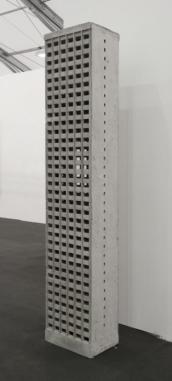 Whiteread’s images from the series “Demolished” that records the demolish of social housing . The Tate website describes that “These images were made at a time of increasing social inequality and homelessness and record the failure of this utopian optimism.” A failure that hit home after the tragedy. Whiteread’s discontent at the homelessness epidemic in Britain can be compared to the discontent at the homelessness of the surviving victims, as Seraphima Kennedy writes for The Guardian: “The Grenfell victims are forgotten people the politicians have failed”. Another controversy within the tragedy was when residents at Kengsinton refused victims into their neighbourhood, a headline by The Independant stated that “Wealthy Kensington resident says Grenfell Tower victims shouldn’t be given shelter in luxury flats” with residents claiming that “Our council tax bill is very, very high, our service charge bill is very, very high, so why should someone get it for free?” as if the trauma, loss of home and possibly the lives of loved ones wasn’t price enough. This incident furthered a feeling of class tension that was construed within the tragedy. The corpse of the burnt building stands in effigy like the empty, carcass shell of marwan rechmaoui’s “monument for the living”, a replica of the Burj al Murr building in Beirut, “The tower is too tall to knock down and too dense to implode, and so remains as a blight on the skyline and, for many artists and thinkers of Rechmaoui’s generation, an appropriate memorial to the fratricidal conflict that has never been fully resolved and has yet to be commemorated by any public gesture of reconciliation.” (Tate)
These works become the prophesied illustrations on the wall of contemporary society. They allude to the statement that “art imitates life” as the original pieces were a commentary on reality, however, they can also be seen as confirming Oscar Wilde’s statement that “Life imitates art far more that art imitates life” (1889) as the tragedy of Grenfell Tower follow the warnings that these artists foretold, in the very city it happened. Having seen the works before the accident, I found that the haunting memory of the tragedy becomes apparent when looking at Whiteread and Rechmaoui’s works now, giving the themes explored a sharper poignancy and proving that an event may contribute to our reaction to a piece of art.









 AmyLavernia